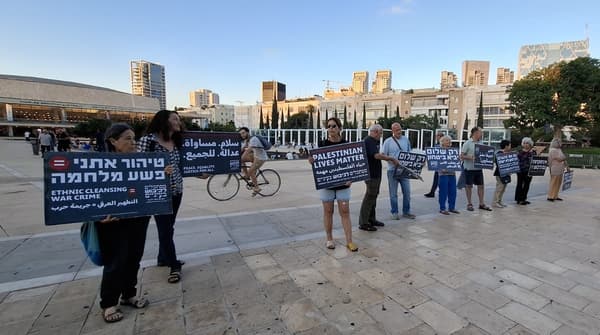


About one thousand people attended Saturday night's main anti-government demonstration at Habima Square in Tel Aviv. Around one hundred demonstrators carrying "Looking the Occupation in the Eye" signs stood nearby. Although settler violence in the West Bank has recently received increased media attention, it has done little to increase public support for a peace initiative. A new poll (details below) shows that unilateral annexation has, for the first time, become the most popular option (30%), while support for the two-state solution has fallen to only 21 percent. "Who would you make peace with?" one skeptic asked during the demonstration. "You make peace with your enemies," came the reply.
The poor turnout at Saturday night's demonstrations across the country suggests that expectations of political change in the October elections have largely paralyzed the former Balfour-Kaplan protest movement. Perhaps it was the July heat, or perhaps emotional exhaustion after three and a half years under a government that brought Israel both its judicial overhaul and the October 7 war. There is growing concern that the climax of the judicial coup—described as a "red line" by the lawyer now serving at the President's Residence—is far more serious than the attempt to abolish the reasonableness doctrine, which previously brought hundreds of thousands into the streets. By announcing that it will ignore Supreme Court rulings, the government of effectively declares that the rule of law is meaningless. If court decisions can simply be ignored, election results could ultimately be discarded as well.
These pages have repeatedly argued that in the West Bank the rule of law is not even treated as a recommendation. Apartheid policies, ethnic cleansing, and disregard for human life and basic rights have continued for years with almost no resonance beyond the Separation Barrier. The warning that these practices would eventually spread into Israel itself is now becoming reality.
Meanwhile, with less than four months remaining before the elections, Netanyahu continues to manufacture a sense of war and national emergency. Even before the current exchange of fire around the Strait of Hormuz, he had spent months preventing the Palestinian technocratic government from entering Gaza. This politics of permanent emergency has already proven effective. It could once again help him remain in power—either because voters believe that "you don't replace a government during wartime," or because the emergency itself could justify postponing elections or delaying their results. Unfortunately, experience suggests that opposition leaders will once again fall silent the moment fighting resumes, just as they have repeatedly done since October 7.
Sunday
Qalandia: A Border Police officer threw a stun grenade into a private vehicle and prevented its passengers from getting out. In a video that quickly went viral, he can be heard shouting at the occupants, "Shut your mouth" and "You son of a bitch." The officer was questioned by the Police Internal Investigations Department and suspended from his unit for eight days.
Also in Qalandia refugee camp, Israeli soldiers shot and killed 16-year-old Walid Nidal Abu Snineh during a nighttime operation.
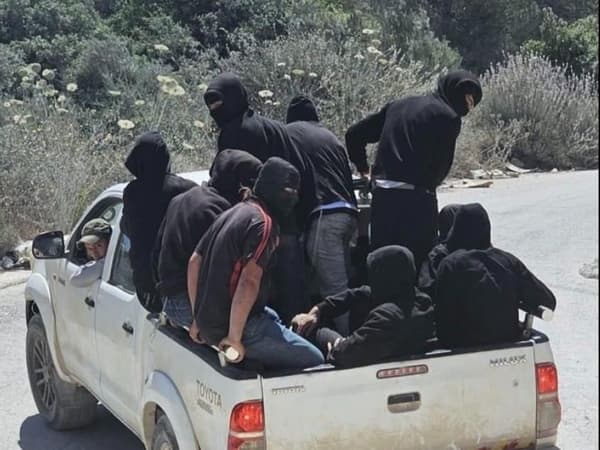
Settlers invaded the home compound of a Palestinian family in the village of Umm Drit in the southern Hebron Hills. They assaulted residents, pushed them and spat at them. Security forces arriving at the scene arrested two members of the Palestinian family instead.
A Palestinian restaurant in Lubban al-Sharqiya was set on fire by settlers. According to the owner, "More than one hundred settlers arrived—and they also opened fire." The head of the local council said the attackers broke in, smashed doors, stole cash and burned the restaurant to the ground, causing approximately one million shekels in damage. "They had threatened to kill me and burn the place more than ten times before. The army stood just 20 to 30 meters away while the building was burning," the owner said. The IDF stated that the suspects had fled before troops arrived.
Monday – The State Prevents the Displaced Residents of Ras Ein al-Auja from Returning Home
Daniel De Malach writes: Anyone who has seriously studied the Nakba (the mass displacement and dispossession of Palestinians during the 1948 Arab-Israeli war) has long understood that the debate over whether Palestinians fled or were expelled misses the central issue. As Danny Rubinstein once wrote, "Whether they fled Jaffa or Acre in panic like Ghassan Kanafani's family, or were forcibly expelled from Lod like George Habash's family, none of them were ever allowed to return home."
What is happening today in the Bedouin shepherd communities expelled by violent settlers operating from so-called "shepherd farms"—in reality outposts established to drive Palestinians from Area C? Are we once again reaching a point where the distinction between expulsion and flight becomes irrelevant because the state itself prevents displaced communities from returning?
Recent Supreme Court hearings concerning the displaced residents of Ras Ein al-Auja strongly suggest the answer is yes.
First, the state refuses to station permanent military forces in the area, citing limited military resources. It is only willing to secure the residents' return during the first few hours.
Second, the state refuses to declare the area a closed military zone, as requested by the residents. Instead, it merely promises that if friction develops after they return, military commanders may consider issuing such an order.
Third, the army prohibits residents from hiring private security to protect themselves against settler attacks.
Finally—and most importantly—the authorities remind the displaced residents that their abandoned homes were never officially authorized under Israeli planning regulations, adding that nothing in the state's position should be interpreted as permission to rebuild them.
The lesson emerging from the state's response is clear. While claiming that the police and military acted to prevent harassment and expulsion, the state simultaneously institutionalizes the displacement by denying residents any meaningful protection and threatening to block reconstruction. In doing so, it effectively turns ethnic cleansing in the Jordan Valley into official government policy.
Tuesday
A Palestinian truck driver delivering humanitarian aid for the World Central Kitchen (WCK) in Rafah was shot dead by Israeli forces. According to reports, he was ordered to leave his truck and, while raising his hands, was shot. Haaretz quoted his father: "They shot him between the eyes without saying a word."
A Palestinian resident was arrested while a settler grazed livestock near his home in a village in the southern Hebron Hills. Two more residents were arrested in the nearby village of Fakhit. All three were released several hours later.
In a recording broadcast by Channel 24i, the head of the Shin Bet reportedly stated: "The use of human rights arguments in these proceedings is complete nonsense."
Wednesday – Unilateral Annexation Becomes the Most Popular Option
Dr. Shaul Arieli published a new survey conducted by Tamarur–Politography among Israel's Jewish public at the end of June. The results present a clear picture: Israel's Jewish majority no longer seeks a political solution and has become accustomed to living without one.
Support for the two-state solution has fallen from 47 percent in 2018 to only 21 percent today. For the first time, unilateral annexation has become the most popular option, supported by 30 percent of respondents. Another 25 percent prefer maintaining the current status quo. In other words, most respondents do not seek separation from the Palestinians but rather continued Israeli control.
A striking contradiction also emerges regarding regional cooperation. Fifty-six percent support Israel joining a coalition of moderate Arab states, and 53 percent believe such an alliance would strengthen Israel's security. Yet when respondents are told that such a coalition depends on reaching an agreement with the Palestinians—a prerequisite for normalization—support collapses to just 20 percent.
The survey also found increasing hardline attitudes regarding Jerusalem and the Temple Mount. Only 11 percent support dividing Jerusalem into Israeli and Palestinian capitals, while a majority favors strengthening Israeli control over the Temple Mount even at the cost of unrest and damaged relations with Jordan and the Gulf states.
The survey also revealed a troubling gap regarding settler violence. Many respondents condemn it in principle, but far fewer support meaningful law enforcement against those responsible.
Dr. Arieli concludes that Israel's Jewish public wants security without an agreement, control without responsibility, democracy without equality, and regional alliances without Palestinians. This is not a strategy—it is a carefully maintained political illusion.
(The survey was conducted by Professors Sivan Hirsch-Hoefler and Gilad Hirschberger, with research assistants Meitar Sorek, Romi Yosef Binyamini and Yonatan Yosef Meiri.)
Armed settlers harassed Democratic Congressman Ro Khanna during a visit to the abandoned Palestinian village of Khirbet Zanuta in the southern Hebron Hills. Settlers blocked his delegation's minibus for about ninety minutes, kicked the vehicle's tires, shouted insults and provoked those inside. The IDF later stated that the visit had not been coordinated.
At the illegal outpost opposite Khirbet al-Tawail, settlers began constructing a corrugated metal building.
The IDF demolished homes in Idhna near Hebron and in Sur Baher in East Jerusalem.
Thursday
In Umm al-Khair, in the southern Hebron Hills, members of the Salem family were allowed to enter their sheep pen for the first time since the area was declared a closed military zone. A Civil Administration officer permitted them to feed and water their goats.
According to the organization Mothers, which accompanies the family, while the officer allowed them to enter, a settler occupying the family's yard—the same man previously photographed sitting on a swing placed beside the family's toilet—began shouting in protest. Shortly afterward, the officer ordered the family to leave.
MK Yasmin Sacks Friedman (Yesh Atid) later announced that, following conversations with senior military officials, she had been informed that the family would continue to be allowed access to feed and milk its herd. Nevertheless, the closed military zone order remains in effect.
Seven Palestinians, including two children, were injured near their home in Masafer Yatta after being attacked by settlers. According to reports, the attackers sprayed pepper spray and beat members of the family. Three Palestinians were arrested.
Friday
In al-Mughayyir, near Ramallah, one Palestinian was wounded by live fire, two others were injured by rubber bullets, and a ten-year-old boy suffered a head injury from a stun grenade during a joint military-settler operation ostensibly aimed at recovering allegedly stolen livestock.
A settler accompanied by a flock from the Tel Talpiyot outpost entered the Palestinian village of Qusra.
Saturday
Haaretz reported that settlers invaded Palestinian villages and attacked residents in at least twenty separate incidents over the weekend. The attacks included physical assaults, armed threats and destruction of property. An Israeli military vehicle was documented providing security while settlers planted Israeli flags inside Area A.
Four settlers were arrested on suspicion of slashing the tires of a CNN news vehicle. The settlers attacked Palestinians and American journalists near the village of Sinjil, north of Ramallah.
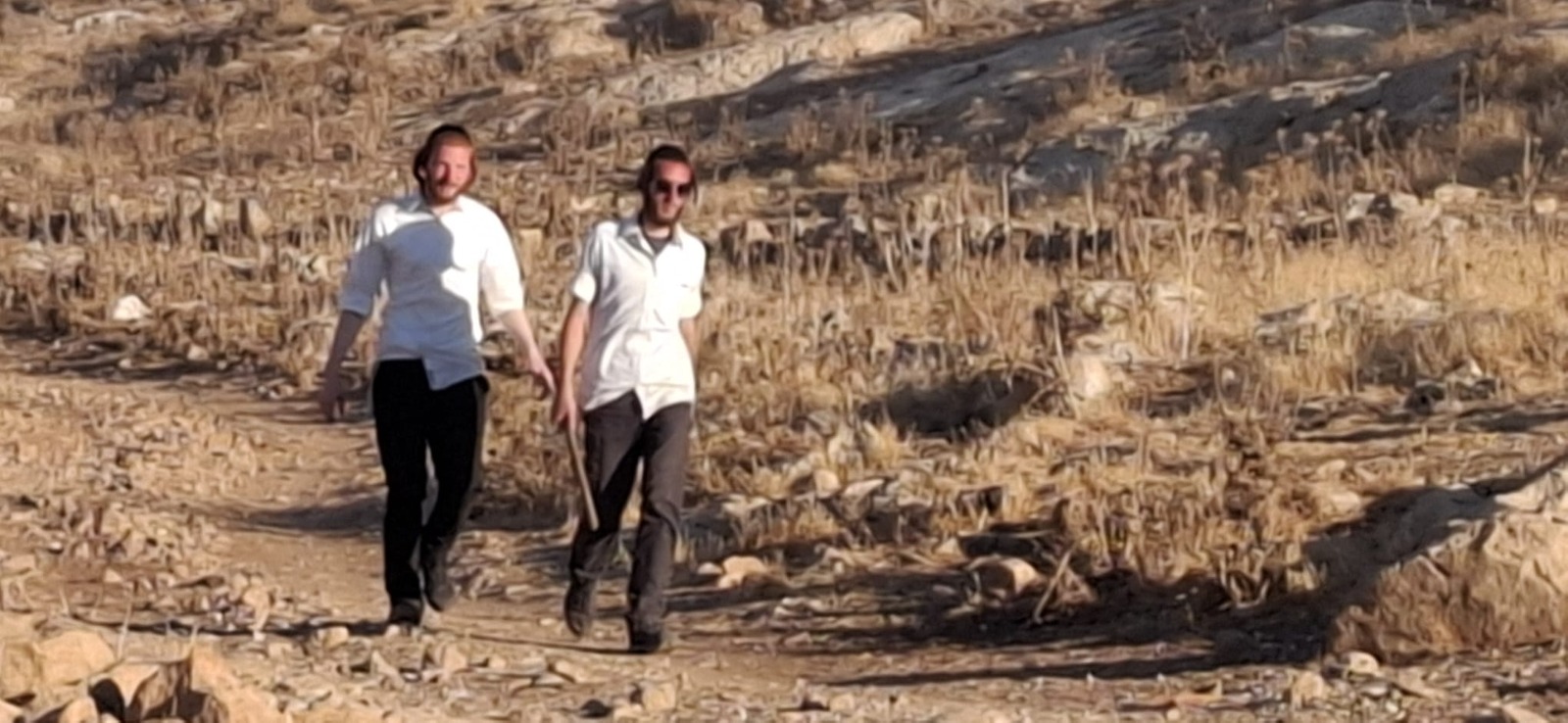
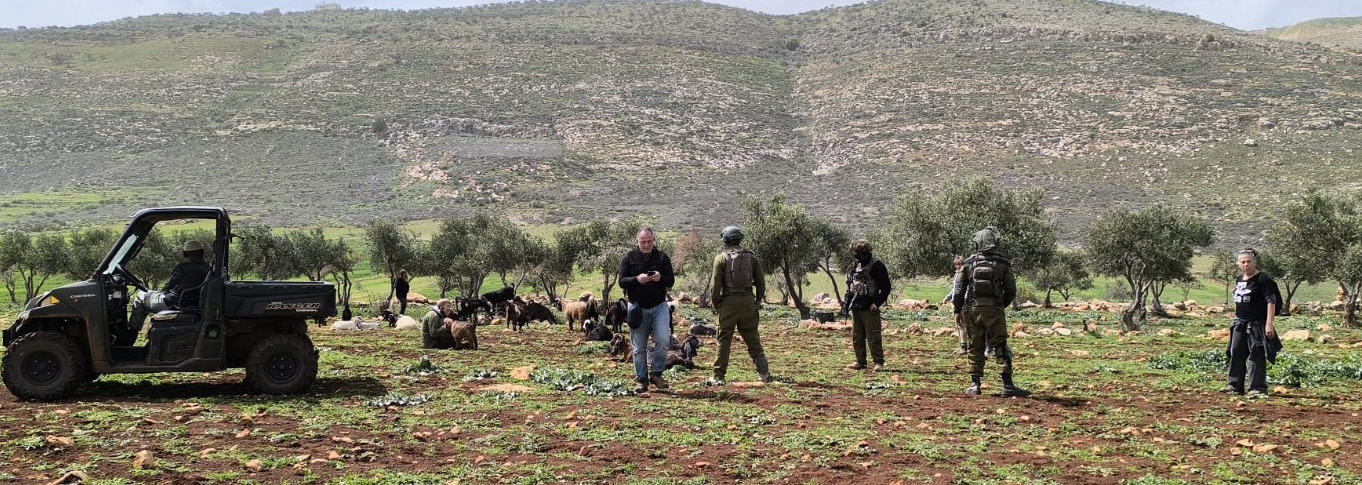
Two guests staying at Noam Jackson's Farm, located adjacent to the Palestinian community of Khirbet al-Tawail, decided to spend their Sabbath accompanying goats to pasture. When they encountered protective activists from Mistaclim (Looking the Occupation in the Eye), they retreated, leaving the herd unattended for several hours. Their Sabbath outing did not end as planned.